Facebook 'friend' ploy costly for woman
Facebook scammers have reached another rung on the rip-off ladder, now hijacking the network's live chat system to cheat users out of cash.
Experts say the con artists are getting more confident with every success and will learn details about the person whose profile they have hacked in order to appear more convincing.
A Hamilton woman recently lost $ 500 to the ploy, after "her friend" appeared on Facebook chat claiming she had been mugged in Manila and needed funds to fly home.
"I believed every minute of it," Claire Spring said. "I rushed around panicked to send the money and it wasn't until my daughter came home and asked if I'd checked if it was really my friend that I began to think, but by then it was too late."
Her friend Julie, who is now concerned for her privacy and didn't want her last name used, said she still felt guilty about what happened, although it wasn't her fault.
"It's so scary. How they got into my account is way beyond me." Another friend, Paul Evans-McLeod, was also nearly taken in by the scam, but recovered enough to ask some security questions. He then raised the alarm, emailing Julie and then his friends with a copy of the conversation to help them avoid the trap.
"It was just the last couple of comments that raised my suspicions," Evans-McLeod said.
"They were saying `go now', `go quick' and I thought it wasn't the way Julie would have spoken to me."
Netsafe executive director Martin Cocker said that reaction was completely natural.
"Because it's contact through a real-time system people are much more likely to fall for it," he said.
Cocker said Facebook users needed to ensure they had strong passwords, and be aware, because once scammers hacked into a profile they could use that information to fool others.
"Scammers are investing more and more time in higher return scams so they will make the effort of chatting with you because it pays off." Cocker said Facebook was a regular target.
"It's a natural evolution on the hacking on the email account, except they can learn a lot more about you."
Both Spring and Julie reported the scam to police and the FBI online scam reporting system.
A police spokesman said the reality was that if people sent money to an unknown person overseas and it turned out to be a scam there was little that could be done to get the money back.
If you believe you have been the victim of a scam you can report it to the online reporting tool The Orb run by Netsafe.
- © Fairfax NZ News
 Read More @ Source
 History of Greed: Financial Fraud from Tulip Mania to Bernie Madoff
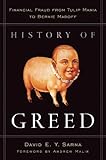 Praise for HISTORY OF GREED
"David Sarna is a visionary technologist. He is also a sophisticated investor and financier. He has written a readable, comprehensive, fascinating, and well-researched book that explores troublesome aspects of the financial system in a way only an experienced insider could."
—Jay N. Goldberg, Senior Managing Director, Hudson Ventures
"A comprehensive review of what has happened to us in our financial markets over and over and over and over again. It's an important history, written with wit and delivered with wisdom. Undoubtedly, History of Greed will become required reading for anyone serious about understanding the capital markets."
—Frederick L. Gorsetman, Founder and Managing Member, Oxbridge Financial Group, LLC
400 years of financial fraud in the making
From the earliest financial scams of the seventeenth century, through the headline-grabbing Wall Street scandals of our times, History of Greed provides a comprehensive history of financial fraud. In it, David E. Y. Sarna exposes the true and often riveting stories of how both naïve and sophisticated investors alike were fooled by unscrupulous entrepreneurs, lawyers, hedge fund managers, CPAs, Texas billionaires, political fundraisers, music managers, financial advisers, and even former Mossad agents. From the people behind the financial fraud and how they did it to why people continually fall prey to scam artists, Sarna outlines what actions you can take today to protect yourself from becoming the victim of tomorrow's "too good to be true" investment opportunity. History of Greed details how markets are manipulated, books are cooked, Ponzi schemes are hatched, and how the government only closes the barn door once the cows have all escaped.Praise for HISTORY OF GREED
"David Sarna is a visionary technologist. He is also a sophisticated investor and financier. He has written a readable, comprehensive, fascinating, and well-research! ed book that explores troublesome aspects of the financial system in a way only an experienced insider could."
—Jay N. Goldberg, Senior Managing Director, Hudson Ventures
"A comprehensive review of what has happened to us in our financial markets over and over and over and over again. It's an important history, written with wit and delivered with wisdom. Undoubtedly, History of Greed will become required reading for anyone serious about understanding the capital markets."
—Frederick L. Gorsetman, Founder and Managing Member, Oxbridge Financial Group, LLC
400 years of financial fraud in the making
From the earliest financial scams of the seventeenth century, through the headline-grabbing Wall Street scandals of our times, History of Greed provides a comprehensive history of financial fraud. In it, David E. Y. Sarna exposes the true and often riveting stories of how both naïve and sophisticated investors alike were fooled by unscrupulous entrepreneurs, lawyers, hedge fund managers, CPAs, Texas billionaires, political fundraisers, music managers, financial advisers, and even former Mossad agents. From the people behind the financial fraud and how they did it to why people continually fall prey to scam artists, Sarna outlines what actions you can take today to protect yourself from becoming the victim of tomorrow's "too good to be true" investment opportunity. History of Greed details how markets are manipulated, books are cooked, Ponzi schemes are hatched, and how the government only closes the barn door once the cows have all escaped.

Fraudulent Stories Here


Comments
Post a Comment